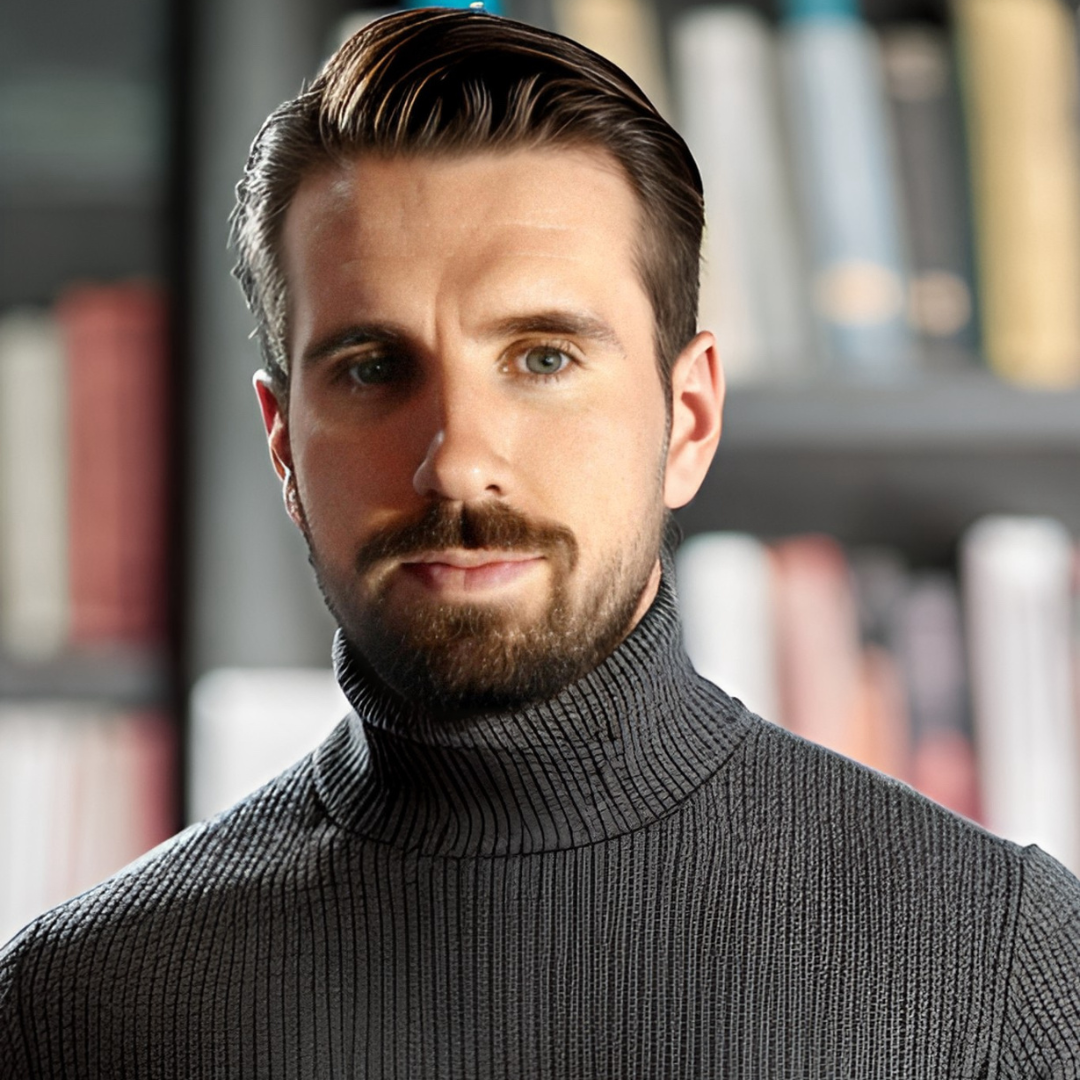
Who Is Ash Borland?
Who Is Ash Borland?
I'm Ash Borland, a UK business coach for self-employed mortgage brokers, working one-to-one under the brand Simplify Success. Over the last seven and a half years I've coached around 362 advisers, and several of the coaches this industry now turns to were built, at least in part, in rooms with me. I've kept most of that quiet, which is sort of the problem.
The belief underneath all of it is simple. When structure improves, confidence follows, and when confidence follows, income stops being stressful. That's the version that fits on a business card. The longer version is stranger, because almost none of it started in mortgages.
Most people in this industry meet me as the bloke on their screen talking about sales, protection and content. What they don't know is that before any of this I was a musical theatre performer, a dance teacher and an estate agent, and that nearly everything I teach now I learned in rooms that had nothing to do with a mortgage. I've set down the full record of the brokers, coaches and businesses I've helped build in its own piece. This is the other half. Where I actually come from, what shaped how I think, and what I'm building it all for.
My dad, and the only lesson that mattered
My dad spent his whole career in financial services, as a training and development director. He built the sales processes and the compliance processes for some of the biggest names in the business, Just Mortgages, Connells, and others before them. He started out in sales and ended up being the man who trained the salespeople. Mr Corporate, through and through.
As a kid I didn't think much of it. He was just Dad. He'd come home, play games, get on with life. I was a touch more curious about his work than most kids are about their dad's, but only a touch. What I didn't realise at the time was how much of him was going in by osmosis.
There's one lesson of his that never left me. My dad wasn't a chest-beating alpha. He wasn't a leader in the loud sense at all. But he would stand in a boardroom full of people far more senior than him, get shouted at, get told he was wrong, and not move an inch. I asked him once why he wasn't scared. He said he had nothing to be scared of, because he knew his stuff. Valuable people get kept. If you become a genuine expert, properly, not a dabbler, you earn the right to say what you think and do what you want. That's rarer than it sounds. Most people never put in the hours to get there.
The irony is that when I told him I was leaving the corporate world to do my own thing, he told me I was making a mistake. He was a status-quo man. Follow the path, keep your head down. A boss of mine at the time said something similar, that I hadn't been doing it long enough to have earned the right to talk about any of it. Hearing it from two people I genuinely respected was the moment I knew I was onto something, because I believed in it enough to ignore them both, and I almost never went against my dad. He's since told me, plainly, that he was wrong and I was right. Not a sentence many dads find easy.
The thing that taught me most about him, though, came later. My dad retired in his fifties, and almost overnight he became a different man. He grew his hair out, grew a beard, got into motorbikes, started day trading, took holidays, went back to the cars and the building he'd always loved as an engineer by trade. For my entire childhood he'd been one thing, and the moment he was free he became another, the one he'd quietly wanted to be all along. He hadn't been false. He'd been loyal. But he'd put the life he actually wanted on hold for decades. I watched that happen, and somewhere in it is the reason I do everything the way I do it now. I took the craft he'd built for the big corporates and handed it to the independents. And the older I've got, the more I've gone back to him and asked how he'd handle the FCA, or a difficult training room, because his knowledge is worth more than almost anyone's I know. When I was young I thought I knew more than him. I was wrong about that too.
The performer
Before the suits and the spreadsheets, I was a performer.
I started as a breakdancer and a street dancer, good enough to compete, and I began teaching young. By fifteen I was running my own dance school of around 350 students underneath my mum's, teaching breaking and street, and I kept that going until I was twenty-five. Somewhere along the way it turned out I could sing, which I hadn't known, and that pulled me into musical theatre. Singing, acting, dancing. That became the career.
And it was a career, not a hobby. I had an agent, I had a scholarship at one of the top colleges in the country, I gigged, I got cast, I worked. The deposit for my first house came out of performing. I say all this because people hear "performing arts" and picture amateur dramatics, and it wasn't that. It was the real thing, full-time.
Performing taught me the single most useful thing I know, and I build entire businesses on it now. Visibility beats ability. The most talented people in my year, genuinely some of the best dancers I've ever seen, often didn't get the work. The ones who got cast were the ones people remembered. They had a look. They stood for something. They were known to the teachers and the casting directors. I worked this out by watching, and I made a decision off the back of it. I wasn't the most flexible dancer in the room, so I'd be the one people remembered instead. I leaned into fitness, grew the hair out, built a whole look around it, very much the Aragorn and Game of Thrones end of things at the time. That's also where the cowboy boots came from, and I still wear them to this day. I see the exact same pattern in mortgages every single day. The brokers who win are almost never the most technically gifted. They're the most visible.
The best example of the flip side is my closest friend, who I've known since we were fourteen. He trained at one of the very best colleges in the country on a full scholarship, and he's one of the finest dancers I've ever seen. He never quite got cast for the big parts. Too good-looking for the chorus, the feedback went, and his voice wasn't quite strong enough to lead at the time. Always the bridesmaid. And here's the thing. He went off and did brilliant work on cruise ships, met his wife, moved to America, and is now a hugely successful real estate agent over there, using the exact same skills I use here. We still speak every Monday without fail. Two performers, two careers that quietly turned into the same kind of work. The talent was never the problem. It rarely is.
Performing also gave me a thick skin, fast. There was no HR backstage. You'd get called short or fat to your face. I'm not defending that, and I once had an artistic director publicly tear me apart in front of 150 people over my tattoos, purely because he was in a foul mood and wanted to destroy someone that day. It felt rotten. But two things stuck. First, that I was only ever as good as the work I was putting out, and I wasn't entitled to anything. Second, that he remembered me. People remember what you say to them, good and bad, especially when it comes from someone with a bit of power. I've been careful with my words ever since, because a throwaway line from you can sit inside someone else for years.
So why did I leave something I was good at and getting cast in? A few reasons, and I still chew on it, because part of me feels like I threw an opportunity away. The honest one is that something else had quietly got its hooks into me. My then-girlfriend got a job in estate agency, through my dad, and I became quietly obsessed with it. I'd lie awake wanting to be an estate agent, of all things, which made no sense to anybody. Underneath that was a bigger thing. I've wanted, for as long as I can remember, to be a husband and a father and a proper provider. Boring, I know. And I couldn't see how the performer's life got me there. I had friends in their thirties leaving that world with nothing, starting over at the bottom, and I thought, if I'm going to start, I should start now, while I'm young, so I've got a head start at getting good. I'm a failed performer, technically. We all are. But I didn't leave in defeat. I'd found something I wanted more. Years later, a lot of those same friends came to me for help making the same leap, and I got to be the proof that there's a good life on the other side of it.
The estate agent, and Tony Green
My first proper job out of that world was as an estate agent in Hertfordshire, and I landed on my feet in a way I've never forgotten.
I was paired with the branch manager, a man called Tony Green, who'd run the same branch for forty years, was friends with half of Pink Floyd, and was about as eccentric as they come. He took me under his wing and became a father figure. I sold a house on my first day. I was listing within a fortnight. For two years I shadowed him everywhere, valuations, building sites, new homes, sales, and it was the best apprenticeship I could have asked for. Out of everything I've done since, performing, broking, coaching, those two years with Tony might be the happiest I've been in any job.
Tony taught me the same lesson performing had, from a different direction. You don't sell property. You sell yourself. He also taught me that people are nowhere near as rational as you'd hope. The same seller who'd refuse to drop their asking price by a penny, because the market was strong and their house was worth every bit of it, would go and lob an insulting lowball at someone else's house the same afternoon, because suddenly the market was terrible. Humans don't run on logic. I'm a logical person, and learning that early saved me a lot of wasted breath. You don't win people with logic. I see it every day now, in my comments and on my calls, and I've long since stopped trying to argue anyone into anything.
This was also where the two halves clicked together. My dad had taught me to be the most knowledgeable person in the room. Performing and Tony had taught me to be the most visible. On their own, each only gets you so far. Visibility without substance runs out. Ability without visibility never gets seen. Put the two together and you're close to unbeatable, and almost nobody bothers to build both. That combination is the thing I've chased ever since, for myself and for everyone I coach.
The broker years, and the moment it broke
From estate agency I went into mortgages, as a broker at Connells, and I got lucky again.
I was dropped into a team that happened to contain five of the top ten performers in the entire group. I took top newcomer in my first year, and it paled next to the people around me, who were writing mortgages at a rate I could barely believe. So I did the thing I always do. I shadowed them, sat in their offices, soaked it all up. I didn't really know what I was doing. I was just hungry, and the people around me were exceptional.
But I watched those same top performers burn out. Properly. Getting ill, looking wrecked, never home, missing things. And it started to dawn on me. The career could make good money, but in that setup it would cost me the exact thing I'd left performing to protect. My wife was thriving in her own career, and the whole point, the thing I'd been driving at since I was a kid, was to build a life I could actually be present in. I started planning a way out.
Around the same time I got disillusioned with the politics. We had a brilliant team, and I watched the wrong sort of people quietly take it over, rewarding the wrong things and behaving in ways I won't go into but didn't respect. I'm like my dad in this. I don't just look at what someone does, I look at who they are. Are they a good person? Some of the people I'd looked up to turned out not to be, and that knocked me. It started to feel like a boys' club, and I lost my appetite for it.
So I left, and joined an independent firm. The role itself didn't work out commercially, and that's the truth of it, but the two men who ran it were good people, and one of them is still a close friend today. More than the job, they showed me a whole world I hadn't known existed. The independent, holistic side, where the income ceiling was far higher than anyone in the corporate world admitted, and where a lot of established advisers had gone soft precisely because the money was easy. I'd found a different way of doing things. The only problem was that I now had to generate my own leads, and I'd never had to do that in my life.
Mark, and the leap
That brings me to the hardest year of my life, and the two things that came out of it.
Out on my own, failing to bring in leads, scrambling, I met a behavioural economist called Mark. Mark became a mentor and a friend, and he did something nobody else had managed. He showed me why everything I'd been doing on instinct actually worked. I already had the what. I'd absorbed it from my dad, from Tony, from the top performers I'd shadowed. Mark gave me the why, and once you understand why something works, you can take it apart, rebuild it, and teach it to anyone. I got obsessed, which is my factory setting. He also told me something that lodged itself in my head. He said I'd never be the best mortgage broker, because there were simply too many of them, but that I could be the best at something else. He planted a seed and didn't even know it.
The seed grew during COVID. I'd already started a bit of coaching on the side, mostly helping brokers with social media and video, almost as a hobby. When the pandemic hit, my wife and I sat down and made a bet. We reckoned there was about to be a rush of people wanting help getting themselves online, and that I could be the one to help them. So we did something that, written down, looks insane. We shut the mortgage business, remortgaged the house, put the money in an offset to live on, and I went all in on coaching. She was pregnant with our first child at the time.
The moment I knew it had worked, I was in the car. Someone had just paid me five hundred pounds to spend a day helping with their brand and marketing, something I'd happily have done for nothing. That person is one of my best friends today. I rang my mum from the car park and told her this was it. And it was the same feeling I'd had years earlier about estate agency. I wasn't running away from broking. I was being pulled towards coaching. The tectonic plates underneath me had shifted, and I knew exactly where I was going. That single five-hundred-pound day became seven and a half years and around 362 clients. But the version of me who could pull it off had been thirty years in the making, which is really what this story is about.
How my brain actually works
There's a part of how I'm wired that explains more about me than anything else, so I'll be straight about it.
I'm dyslexic, and I have been since I was a child. My mum's the same. I can't really spell and I find reading hard, so I listen to audiobooks instead, and it's never held me back. A few years ago I also got diagnosed with ADHD, as an adult, and that came about in a roundabout way. My son started showing signs of being wired differently, and when we looked into it the doctor mentioned it can run in families. So I got myself tested, mostly to understand him. The diagnosis came back, along with a cognitive score that was, frankly, not what a man who can't spell his own surname expects to hear. For most of my life I'd assumed I was a bit thick, because of the dyslexia, and here was a piece of paper telling me otherwise. It explained a lot. The pattern-spotting, the obsessiveness, the way my attention works.
Here's my slightly unpopular take on it. I don't think the world owes me an adjustment because of how my brain works. That's on me, not on anyone else. It's the same view I've always had about the dyslexia. My job is to understand how I function and build around it, and the way I do that is systems. I describe it as riding the dragon. My attention is going to bounce around no matter what I do, so I build rails for it to crash against, and it still hits the pins. I run my days on rules I treat as completely non-negotiable, because decision fatigue is real for me. I stack everything, so one thing leads to the next without a decision in between. The honest, slightly grim proof of it is that if I skip the gym, there's a decent chance I won't even brush my teeth. When the systems are in, my life is good. When they're not, it falls apart. There's a whole idea in Atomic Habits about identity-based habits, and when I read it I had the experience I keep having with these books, where someone's put a name to a thing I'd already been doing for years.
This matters because it isn't a quirk I keep to one side. It's the engine of everything I teach. When I tell a broker to build a default diary, or a repeatable sales process, or a content system, I'm not handing them theory I read somewhere. I'm handing them the exact thing that keeps my own life from falling apart. Structure isn't a nice-to-have for me. It's the single thing that made me successful, and I've watched it do the same for people who'd spent years assuming they were just disorganised by nature.
What I actually do, and what I believe
These days people file me under "the marketing guy," and it drives me a bit mad, because I haven't really been that for years. I started in social media and video, so the label stuck and never got updated. What I am is a business coach. I help mortgage advisers fix the whole engine of a business, the sales, the protection, the retention, the hiring, and I help them through whatever real problem is in the way that week. There's a stoic streak to how I work, the Marcus Aurelius line about the obstacle being the way. The thing in front of you isn't stopping the work. Quite often it is the work.
The convictions underneath it are strong, and a few of them get me into arguments. I coach one-to-one only, capped at around fifty people, and I'll keep it that way even with a waiting list, because the value was never the information, it's accountability, and you don't get that from a room of competitors. I think our job on protection is to eliminate a client's risk properly, not to quietly decide on their behalf that real cover is too expensive. And I back the small independent broker over the empire builders every time, because almost nobody actually needs the empire. Most people need a calm, profitable business that gives them their life back. That's the whole of Simplify Success in a sentence. I've argued all of it at length, and shown the work behind it, in the record of the brokers, coaches and businesses I've helped build. This piece is the why behind the man making those arguments.
The quieter stuff
For someone whose job is to stand in front of a camera and sound certain, I carry more doubt than people would guess, and I've decided to stop hiding it.
I live with anxiety, daily. I get on calls still half-expecting someone to call me a fraud, despite years of evidence telling me otherwise. The strange part is that I know I'm not a fraud. I've got the proof, hundreds of clients, thousands of hours, results I can point to. But the anxiety doesn't care about evidence. It lives in my head rent-free, and a while ago my wife said something that stuck. We're all overthinkers, she said, so why not overthink the good things for once. I'm still working on that one.
There's a money version of the same worry. For a long time I kept asking myself how much would be enough to feel secure as a provider, and the honest answer turned out to be that there isn't a number. I'm not actually money-motivated, I don't live a lavish life, I'm a serial saver, and still the anxiety invents money troubles I don't have. Nobody wants to hear about a reasonably successful bloke fretting about money he hasn't lost, so I don't tend to say it. But it's true, and it's part of the picture.
My other great weakness is that I'm too kind, and underneath the kindness, naive. I'll share my best processes with people who turn round and use them against me. I've coached my own competitors. I've said yes to people I should have said no to, because someone tells me they need help and I find it almost impossible to refuse. The boundaries I do hold, I learned the hard way. I'm strict on payments and strict on my diary now, because I worked out that the moment you bend your own rules for someone, they'll expect you to bend them every time. Those rules aren't me being difficult. They're me protecting the thing that lets me help everyone properly.
I'm telling you all this on purpose. I spent years being the puppet master, the one with the strings who nobody saw, and part of growing up has been deciding to be a bit more visible about the messy bits too.
What I'm building it all for
So what's all of this actually for?
The same thing it was always for, since I was a kid with a vague idea that I wanted to be a good husband and father and provider. I wanted a life on my own terms, and I wanted to be able to protect my family from whatever came at us, the known and the unknown. COVID taught me that lesson hard. If I owned my life outright, I could take a lot of the fear off the table.
So here's what most people don't know. When the business took off, we didn't change a thing. My wife and I stayed in our two-bed mid-terrace with two kids and a big white Samoyed, and we slept on a sofa bed for five years. We weren't skint. We did it on purpose. We kept living on exactly what we'd always lived on, I drove a 25-year-old Toyota Yaris, and we put everything towards owning our life. We paid the mortgage off, kept saving, and in January 2026 we bought our forever home, a four-bed, practically without a mortgage. We're renovating it to be the place we stay in for good. My wife, who had a flying career of her own before all this, is now a director in the business and homeschools our children, and we've got a third on the way.
I work out of a recording studio in the garden, with the old games consoles and a guitar in the corner. A genuinely good day looks like this. I walk the dog, I go to the gym, I make a proper pot of coffee, I sit and listen to my kids tell me about horses and whatever else they've been up to, I kiss my wife, and then I coach from nine till six, an hour on and an hour off, making content in the gaps and checking in with the family between calls. My son, who's not yet seven, runs a little fruit and veg shop out the front and is already making a tidy profit, so the entrepreneur streak has clearly carried down. I do that nearly every day, and I love it. That's the whole point. That's the lifestyle business I teach, and I'm not selling anyone a version of it I haven't built myself.
The goal has shifted lately, though. I'm not financially free, and I'm glad to still work, but I've started caring more about giving something back. I put out a free YouTube channel for people trying to break into this industry, who can't afford me and aren't my clients, because when I started there was nothing like it and I didn't want them getting fleeced by course-sellers. I don't make a penny from it. I just think there should be a voice saying there's another way to do this. You don't have to want my life. Yours will look different. But you should be allowed to build a business that gives you the life you actually want, whatever that is, made as simple as it can be. If I'm honest, that's started to feel like the real job.
If I stopped coaching tomorrow, the thing I'd miss is the conversations. I'm an introvert, I'm wiped out by the end of the day, and I can't stand small talk. But I love getting properly into someone's business, their family, their worries, their goals, and helping them fix something real. That's what energises me. It's the reason I can do twenty-five of these calls a week. It was the bit I loved about being a broker, except now I get to go far deeper. I'd miss that more than anything.
That's who I am, more or less. The same bloke who used to lie awake wanting to be an estate agent, still chasing the same quiet life, now running it from a studio at the bottom of the garden with a guitar in the corner and the kids' voices coming through the wall. That's the whole thing. That's what I built it for.
Where to find me
Work with me. My one-to-one coaching for established brokers. No courses, no group programmes. Just the two of us fixing the structure underneath your business.
Follow me on Instagram. Daily content for brokers, and the fastest way to reach me. My DMs are open and I answer them myself.
The Mortgage Business Mastery Show. My weekly show for brokers. A new episode every Monday, around fifteen minutes, one idea worth your week.
The FREE 14 Day Mortgage Business Boost. One small task in your inbox every day for fourteen days. Do them and your business is in better shape by the end. Costs nothing.
The Broker Book Club. One book a month, chosen so you read less and apply more. The thinking behind a stronger business, without the wading through.